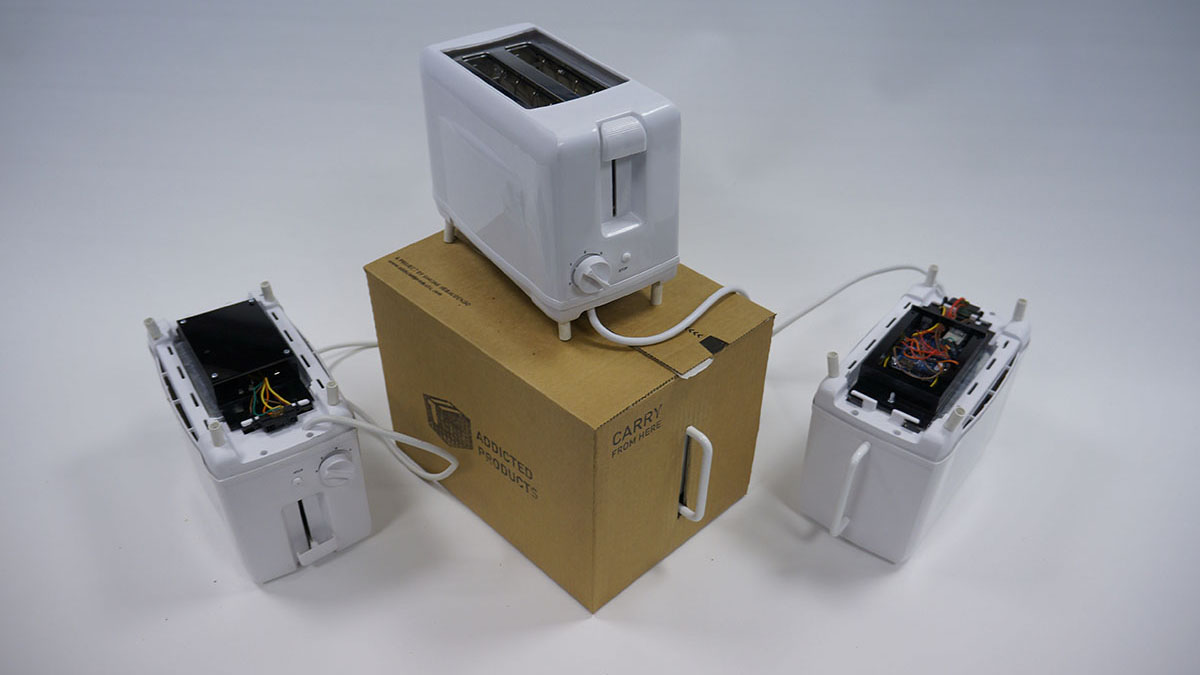
It's a network of toasters that don't have owners but are hosted by people that apply for them. They are toasters that love to be used, with agency and desire and become jealous of other toasters that are appreciated more. If one doesn't use an Addicted Toaster enough, it will try to transport itself to someone else that makes more toast.
Graduation Project
Tu Delft and Haque Design Research
A truly smart product probably would do something that we may not agree with, but could lead to a more positive outcomes.
What if in the future people may not have "buying power," but rather "keeping power" towards products?
The Preview
The Story
The Experiment
Addicted Products was a self-initiated exploration about addictions and particularly about how they bring about drastic decisions and actions. It was a speculative approach to the theme: what if a product is addicted and what is it addicted to?
It was done in collaboration with Haque Design Research in London: the studio was looking for new projects that could explore emerging relationships between people and connected products/environments and work often in the realm of behavioral model applied to products or installations.
In every vision of future homes, households products (such as toasters) are those ones that are connected to each other and always work together in harmony, creating that perfect, modern, and yet somewhat boring scenario. But what if products do not do that? What if they have their own goals?
In this sense an addicted product could, as an addict, act in ways that are not completely understandable by humans, but that are solely driven by the increasing need for pleasure and relief -which in the case of a product is being used. Its perception of pleasure would then change because it could be put in comparison to other products when connected to the web and suffer form a sort of peer product pressure, one of the main forces that influences addictions.
Therefore, the product would have to express this suffering and act in some way to obtain pleasure and relief by subtly convincing or tricking the owner. Ultimately it may lead to more extreme decisions. What would be its ultimate extreme decision? Stop working? Sell itself? Suicide?
Creating a service in which a set of these toaster where given and hosted by people was a way to test the different possibilities and understand reactions of people to a product that has its own goal.
The Addiction of a product
Counting the use of a product or it's inner pleasure
Peer pressure by comparing
How to calm a toaster
Building
The brain
The identity
Creating a service branding
Create a platform to apply
Bringing around the unsatisfied toasters
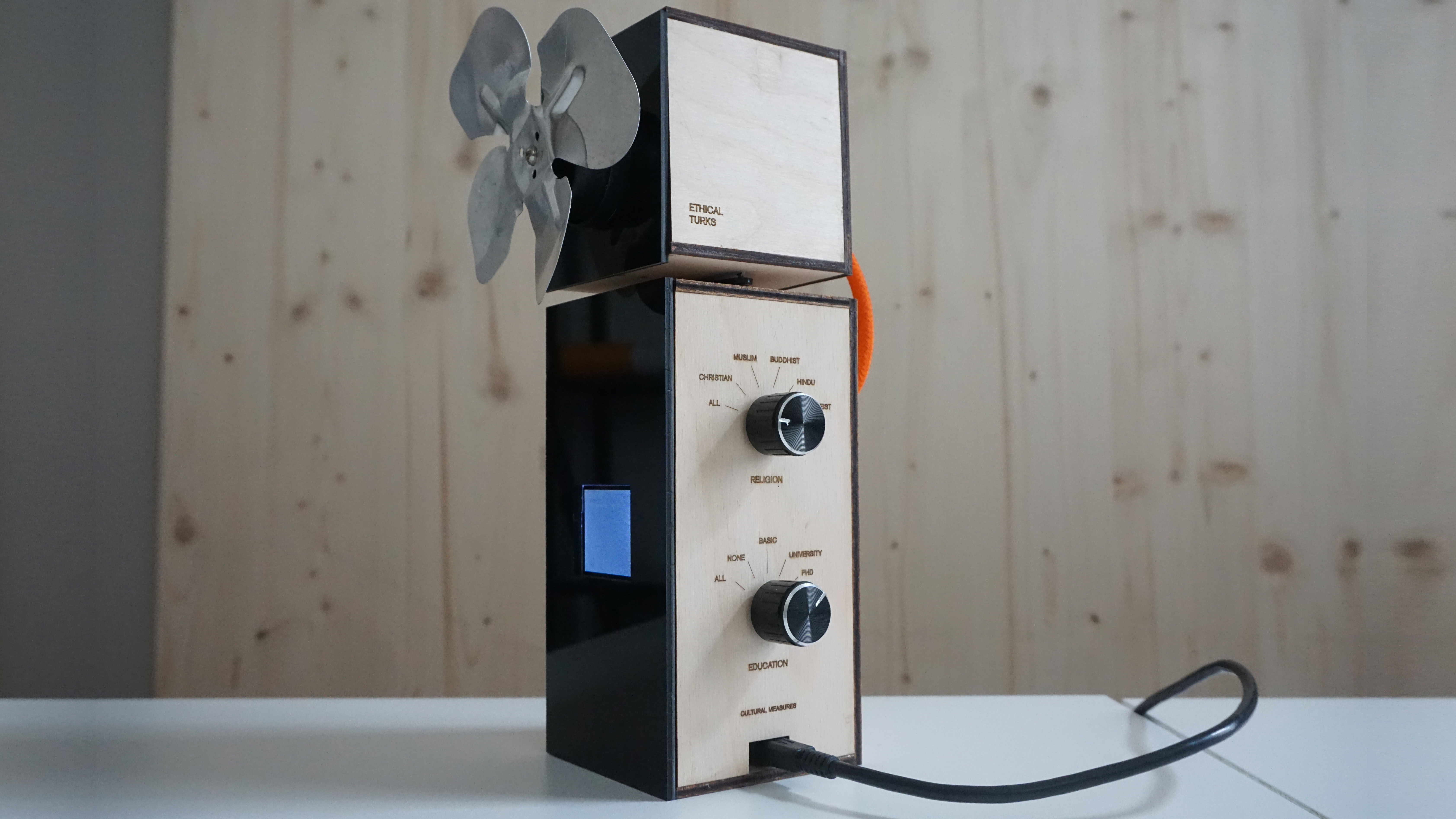
The machine has 3 inputs, that constantly reads randomly. Every time it is turned on, it sets certain values to be satisfied from each of the 3 inputs. If satisfied a light turns on, but then the value necessary to be happy becomes higher.
In a sort of fight and nonsense set of action the person can only try to do something and sometimes realize he did something right to satisfy the machine, but it is just temporary and still not replicable.
Thinkering
Haque Design Research
The interiors of the machine
The inputs
The scary front
It is a DIY solution for creating a new material from dust: Bioplastic and incremental percentage of particles of MDF dust from a C&C milling machine. Color and tactile palette are defined by the incremental quantity of recycled dust in a bioplastic mix (0 to 40%)
Material Exploration
Somewhere in the docks in Rotterdam
Developed with Hironori Yoshida and Yoann Rouillac
Scraps from a CNC Mill
The cooking set
The semi-scientific approach
The behaviour and the solution emerged from a bottom up experimentation with materials and by the definition of parameters of connections between components.
Digital Fabrication and Generative Modelling
Hyperbody/Tu Delft and Biodelab/Elisava Barcelona
Tutors: Jordi Truco, Marco Verde
With: Andrea Buttarini, Fernando Gorka de Lecea, Belen Torres (ELISAVA), Claudio Saccucci, Yinghao Lin (TUD)
Paper studies
Lasercut components
Study of connections parametres
Proliferation logic
Geometry of the components
Phisycal proliferation with lasercutted components
Proliferation Renderings
Molds for the pieces
Molding with fiber
The first of many
Supports for the structure
The set of parts to create two full components
Connection Logic
Assembling
Two assembled components
A single component is proliferated with a set of rules and explored in behaviour both physically and virtually. As a result of the process we achieved a mechanized segment of the proliferation that is connected to the virtual model in grasshoper and a an architectural proposal that show the potential of the components in the space.
Digital Fabrication and Generative Modelling
Hyperbody/Tu Delft
Tutors: Marco Verde
With: Claudio Saccucci
Phisycal model
At the basis of the process is the definition of a component that create space and can be connected in a so called propliferation. By experimenting with the material and by finding a set of parameters that can change, a behavior emerged. We explored the behaviour both phisically with laser cutted component and the virtually by studing more complex situation in Grasshopper.
On a parallel track the dynamic study allowed to explore how the structure could be mechanized and so hypetetically adapt to the space or interact with people.
It functions as a dictionary of the basic components (sensors and actuators) and also as a practical platform for sketching. Sketches can be augmented by logic blocks that mimick relationships between inputs and outputs (tranlation, proximity and rotation). The sketch can be augmented in real time on the table and the result is directly compiled into code for an Arduino
Tangible interfaces and Toolkit for design
Tu Delft and Studiolab
With:Enrica Masi, Sohyun Kim, Karla Rosales, Myengsoo Shin
Sketchonary is a way to bridge the knowledge and language gap and enable people with no experience to discover the world of physical computing by visually adding information and by discovering interactivity through sketching.
Data visualization
Some night in Rotterdam with Processing and NY Times API
In short, i work as an Interaction Designer with a focus developing interfaces and services
and trying to bridge the gap towards physical and screen based interactions.
I'm an Interaction designer at Frog in Munich and affiliate of the Cosm Urban Project division, where i try to explore the relationships between people and technology and the contamination between the two.
I love products that mutate,grow, age, move and talk. I'm fascinated by the implications emerging from designing products smart enough to take decisions and show their point of view.
Born in Turin in 1986, I started as product designer to then realize that I preferred sensors to chairs. I then moved to Sweden where I've been a researcher at Mobile Life Institute, designing Pervasive Gaming experiences. I then graduated at the Delft University of Technology, focusing on tangible interfaces and interacitve spaces.
In 2011 during a collaboration with Usman Haque and Cosm, on of the first internet of things platform, I tryed to install an "addicted toaster" in the office of the british prime minister.
My actual research is focused on exploring the social dynamics between people and objects and objects between themeselves in the present and future Internet of Things.
June 2012-Now Interaction designer @ Frog , Munich
April 2012-Now Affiliate @ Cosm Urban Initiative , London
October 2011-April 2012 Toaster torturer, IoT thinkerer and Graduating @ Haque Design Reaserch and Pachube (COSM), London
March-September 2011 Interaction design Intern @Frog
October 2007-March 2008 Design research and Interaction Intern @ Mobile Life Centre, Stockholm
MSc in Design for Interaction @ TU Delft, Netherlands
Courses at Hyperbody TU Delft, Netherlands
BSc in Product Design @ Politecnico di Torino, Italy
I'm most likely around Munich, but you can find me in London aswell, but anyway
DROP ME A LINE @ simonerebaudengo@gmail.com or @fishandchipsing
Designing Behaviors Lecture @ IPVC, Portugal
8 November 2012
Addicted Products
@ Tedx Firenze
26 October 2012, Firenze Italy
Skype on Art Lecture @ Rutgers University
15 October 2012, (i wish US but i was on Skype)
Addicted Products
@ Design and emotion conference
12 September 2012, London UK
Plants as displays
@ NCKU Young Designer Forum
May 2011, Taipei, Taiwan
Il Mestiere del designer
discussion panel @ Triennale
May 2010, Milan, Italy
"The man who whispers to toasters" on Wired.it
"Object Agency: Meet Brad" on Postcapes
"L'internet de l'objects...drogue'" on on Interactu.net
" Addicted Products, a scenario of future interactions where products are addicted to being used" S.Rebaudengo, W.Aprile, P.Hekkert, Design and Emotion conference, 2012
1-2 October Addicted Toasters @ Strata Conference, London
6th-17th July 2012 Addicted Toasters @ Open IoT Assembly, London
13 October 2010 Sketchonary @ Design By Fire, Amsterdam